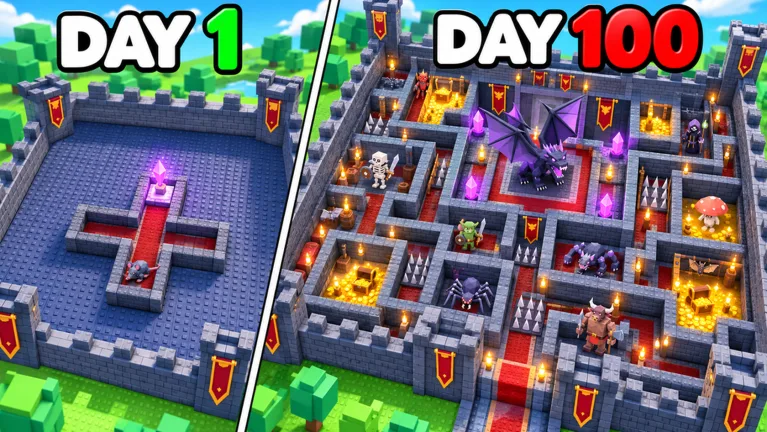
Build a Dungeon Wave 500 Strategy: Endless Wave Defense Plan
Plan a build a dungeon wave 500 strategy in Roblox [GUILDS] Build a Dungeon with decoy mazes, spaced oil and fire traps, potion shop income, and Boss Room units.
Published: Build a Dungeon Wiki Editorial Team
Table of Contents
Mastering the Basics of Layout and Economy
Wave pushing in Roblox Build a Dungeon is a defense loop, not a one-time level. Heroes spawn at a one-way entrance, follow the corridors you place, and try to destroy your dungeon crystal, while Coins pay for buildings and traps and Dark Souls pay for monster units. The hourly Coin and Soul rate in the escape menu scales from your highest wave, so layout quality and income quality rise or fall together.
Recorded community gameplay reaches wave 190 and clears wave 200, and the developers have published no wave 500 milestone, reward or difficulty table. That makes 500 a self-set target for the endless waves: what matters is a route and an income stream that keep working as hero waves scale, not a listed finish line.
Lock the Route From the One-Way Entrance: Build one mandatory path with stone corridor pieces so heroes walk the line you chose instead of spreading across open floor.
Add Decoy Branches: Attach wooden floors and dead-end pieces to that route. Recorded layouts show heroes walking into a dead end, turning around, and looping back through the same hazards.
Place Potion Shops on the Route: Heroes buy potions from the shops they pass on the way in, and recorded players describe that income as one of the main money makers.
Space the Oil and Fire Line: Place oil tiles three tiles apart, counting the oil tile itself, and cover the stretch with fire traps and lava floor, which raises fire damage.
Strategy Phase
Primary Goal
Recommended Action
Early Waves (through the wave 10 checkpoint)
Route and first income
Lay stone corridors, add potion shops, and bank Coins for rolls.
Post-Checkpoint Push
Trap and unit depth
Add decoy dead ends, space oil and fire traps, and place monster units with line of sight.
Wave 190-200 and Beyond
Scaling the run
Feed the hourly rate, filter duplicate rolls, and lean on mutated and Boss Room units.
Designing the Ultimate Maze for High Waves
A straight corridor keeps heroes predictable, but it also hands them a clean run at your crystal. Recorded builds mix the two ideas: stone tiles form the real route, while wooden tiles and dead-end pieces create branches that heroes wander into and back out of. One recorded layout used a decoy section that turned roughly half of the entering heroes off the main line and kept them circling the map, burning health on hazards the whole time.
Hero classes decide how long that maze keeps working. Thieves disarm traps within a one-block radius around themselves, so a single trap line gets stripped as they walk it. Healers keep hero parties alive, and archers can attack through walls even though your own monster units cannot attack through a wall at all. That is why units belong on open corridor sections with clear line of sight, and why Boss Room units belong in the room that guards the crystal.
Tip
Open the escape menu to read your hourly rate. A recorded run at wave 190 showed about 8,400 Coins and 385 Souls per hour, and the figure is calculated from your highest wave. The official game description also confirms that monsters keep catching heroes offline.
Maximizing Passive Income Through Potion Shops
Potion shops are the income engine of a long run. Heroes do not skip them: recorded gameplay shows adventurers buying as many potions as they need from the shops on their route, no matter how many shops are placed, and that Coin flow funds the Dark Souls rolls deeper waves demand.
The treasure room is the second lever. Recorded gameplay confirms heroes are guaranteed to head for a treasure room, so a treasure room placed behind a hazard corridor pulls traffic through your damage instead of letting heroes beeline for the crystal.
Potion Shop Placement
Put potion shops directly on the mandatory route rather than in optional side rooms. Heroes buy from every shop they pass, so chaining shops along one corridor multiplies the same foot traffic.
Treasure Room Routing
Use a treasure room as a guaranteed lure. Heroes always try to reach it, which lets you choose which hazards they cross on the way.
Income Source
Verified Behavior
High-Wave Use
Potion Shop
Heroes buy as many potions as they need from shops on their route
Steady Coin income that pays for unit rolls
Treasure Room
Heroes are guaranteed to head for it
Forces traffic through a chosen hazard corridor
Hourly Rate
Shown in the escape menu and scaled from your highest wave
Grows automatically as your best wave climbs
Preparing Your Units and Gear for Wave 500
Unit rarity is the second axis of progression alongside layout. Monster units come in eight rarities: Common, Uncommon, Rare, Epic, Legendary, Mythic, Secret and Divine. Community gameplay records roll milestones at 80 rolls for a Legendary, 160 for a Mythic, 300 for a Secret and 2,000 for a Divine, while the developers have published no official probability or pity table, so treat those numbers as community milestones and check the in-game interface for current values. Update 6 added Divine and Mutation pity along with auto-roll filtering, which handles the duplicate units and buildings that pile up while you chase those rolls.
Mutations stack on top of rarity. Golden units have 2.4x health and damage, Frozen 3.8x, Infernal 5.6x and Cursed 8x, with Dark Souls costs of 4x, 7x, 12x and 20x and extra population of +1, +2, +2 and +3. Boss units gain 50% more health and damage while they stand in a Boss Room, which makes that room the natural home for them. Players who also fight alongside their units can buy swords and stronger weapons such as a battle axe.
Warning
Secret-rarity units are expensive. A recorded player pulled a Golden Bone Colossus and described the Dark Souls cost as crazy expensive, so keep that purchase inside the income your potion shops and hourly rate already produce instead of spending the whole balance on one roll.
[ ] Confirm every hero wave is forced onto one mandatory corridor from the one-way entrance.
[ ] Check the escape menu hourly rate and compare it with the cost of your next roll.
[ ] Keep oil tiles three apart, with fire traps and lava floor covering the burn stretch.
[ ] Place monster units where they have line of sight, since walls block their attacks.
[ ] Put Boss units inside a Boss Room for the 50% health and damage bonus.
Frequently Asked Questions
Is wave 500 a real milestone in Build a Dungeon?
No wave 500 milestone, reward or difficulty table appears in the game's official material. Recorded community runs reach wave 190 and clear wave 200, so 500 works as a self-set target for the endless waves.
What is the best way to start a build a dungeon wave 500 strategy?
Start with one mandatory stone corridor from the one-way hero entrance, add wooden dead ends as decoys, and place potion shops on that route before spending Dark Souls on rare units. A failed run restarts from the most recent checkpoint, and recorded gameplay shows a checkpoint at wave 10.
How do I stop thieves from disarming my traps?
Thieves clear traps within a one-block radius around themselves, so a single trap line gets stripped as they walk. Overlap trap types along the corridor, keep the oil and fire stretch further back, and back the traps with monster units that have line of sight.
Are potion shops really necessary for high waves?
They are one of the most reliable income sources recorded in gameplay: heroes buy as many potions as they need from every shop on their route, and that Coin flow pays for the Legendary, Mythic and Secret rolls that deeper waves require.
How can I check my dungeon efficiency?
Open the escape menu and read the hourly Coin and Soul rate. It is calculated from your highest wave, and the official game description confirms monsters keep catching heroes offline.