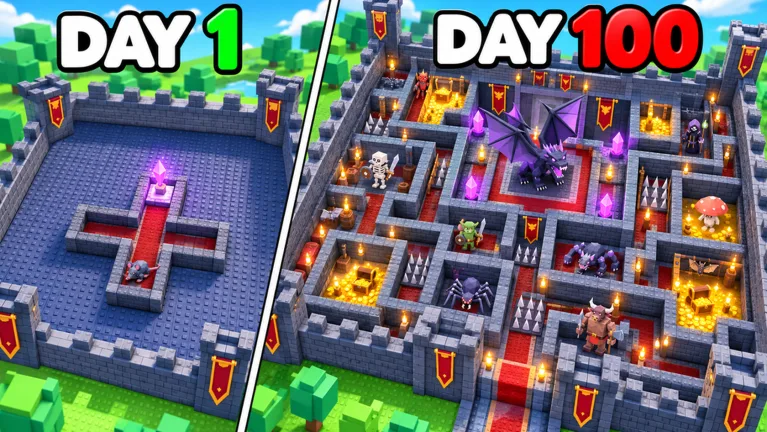
Build a Dungeon Best Traps: Trap List and Placement Guide
Build a Dungeon best traps guide: the full trap list, where to place spike, poison, fire and arrow traps, and how oil and lava floor stack fire damage on the hero route.
Published: Build a Dungeon Wiki Editorial Team
Table of Contents
What Traps Do in Build a Dungeon
Build a Dungeon is Exploration Guild's dungeon-building game on Roblox, still in beta and updated regularly. Its official description sets the loop out plainly: build your own dungeon, defeat endless waves of heroes, put monsters in the dungeon to loot heroes, and collect cool buildings and strong monsters. Traps are the layer of that loop that damages the wave without spending a monster unit on the tile.
Traps and dungeon parts are bought with Coins, and recorded gameplay shows a poison trap carrying a 1,000 Coin price tag. Monster units are the Dark Souls purchase instead: one recorded unit cost 190,000 Dark Souls and another was priced at 220,000.
Placement matters more than count. Heroes enter through a one-way entrance and walk the corridors the builder lays down, and the recorded part list splits the two floor types cleanly: stone corridor is the main path, while wooden floor reads to the wave as a dead end. A trap on a tile the heroes never cross never earns back what it cost.
The Full Trap List and What Each One Does
Recorded builds list nine trap parts, and they do not all do the same job. Grouping them by what the footage shows is the fastest way to decide what a corridor actually needs:
Trap
What Recorded Builds Show
Spike trap, poison trap, bear trap, falling rocks
The direct damage group, placed on tiles the hero wave has to cross. Official damage values are not published.
Tar pit
Slows heroes down only; it is not a damage part, so it buys time rather than kills.
Arrow trap
A wall-mounted trap, so it needs a wall tile facing the corridor instead of a floor tile.
Fire trap
Fire damage, and the trap that recorded runs pair with oil and lava floor.
Oil
A hero who steps on it keeps burning for three tiles.
Lava floor
Raises fire damage on the stretch where it is placed.
The Damage Group
Spike trap, poison trap, bear trap and falling rocks are the parts that hurt the hero standing on them. They are the cheapest way to cover a stretch of corridor your monster units cannot see.
The Fire Stack
Fire trap, oil and lava floor are the one documented combination in the catalogue, because two of the three parts feed the third. The same fire trap hits harder on a prepared stretch than on bare floor.
Where to Place Traps in the Layout
A trap line is only as good as the traffic it sits in. Recorded builds keep returning to the same positions, because each one forces the wave onto tiles the builder chose:
Position in the Layout
Why It Works
Trap to Lead With
Stone corridor on the main route
It is the path the heroes must cross
Spike trap, poison trap, bear trap, falling rocks
Junction and crossroads
The wave turns and strings out across the tiles
Fire trap over oil and lava floor
Approach to the treasure room
The treasure room is guaranteed to pull heroes toward it
Damage group first, fire stack behind
Wooden-floor dead end
The wave turns back out through tiles it just crossed
A cheap damage trap, since that stretch is walked twice
Wall tile facing a corridor
The arrow trap is a wall part and cannot cover a floor tile
Arrow trap
Two other parts change the traffic itself. Curved corridor and curved wall sections lengthen the walk without adding a junction, and gold bait is the one item recorded gameplay shows turning heroes around: roughly 50% of a wave can be sent back over a stretch it has already crossed, which is another pass over the same trap line.
Tip
A hero stays burning for three tiles after stepping on oil, so overlap the oil across a stretch to keep the burn from lapsing between single tiles. Put the fire traps and the lava floor on that same prepared stretch, and mount the arrow trap on a wall that faces the route the wave walks.
Building a Trap Line Step by Step
Fund the line first: the potion shop is one of the main income sources because heroes stop and buy potions on their way in, so let the wave pay for the traps before it reaches them.
Choose the mandatory crossing: stone corridor carries the main path and wooden floor reads as a dead end, so decide which stretch the wave cannot avoid.
Place the damage group there: spike trap, poison trap, bear trap and falling rocks belong on tiles a hero has to stand on, not tiles a hero can walk around.
Mount the arrow trap on a wall: it is a wall part, so pick a wall tile facing the corridor and keep the line of fire clear.
Stack fire on one stretch: oil, fire trap and lava floor together, so the burn keeps reapplying and the fire damage is buffed on the tiles the wave must cross.
Take trap mastery in the skill tree: it lifts every trap at once, alongside gold rush, soul harvest, unit damage, population, battlecry and battle speed, and Update 6 moved the 2x Battle Speed unlock earlier in the tree.
Trap Mastery, Coins and Paying for the Line
The wave is what pays for the layout. The potion shop is a main income source and the treasure room is guaranteed to pull heroes toward it, so both belong on the long route rather than beside the crystal, and the escape menu then reports the result as an hourly rate scaled from your highest wave. Recorded gameplay at wave 190 showed roughly 8,400 Coins and 385 Souls per hour.
Failure is not the end of a layout either: a failed run restarts from the nearest checkpoint rather than wave one, and the recorded checkpoint sat at wave 10 with the restart beginning from that wave. Because the game is in beta and updates regularly, re-read the current update notes and the in-game interface after a patch before assuming a part still behaves the way it did.
Why Trap-Only Corridors Fail
A corridor built out of traps alone opens up as the wave walks it. Thief heroes disarm traps within a one-tile radius of themselves, healer heroes restore health to the rest of the wave, and archer heroes can shoot through walls even though your own monster units cannot attack through a wall at all.
Warning
Do not treat traps as a complete defense. A thief disarms every trap within one tile of itself, so a trap-only corridor is cleared tile by tile while the rest of the wave walks through. Keep monster units on the crossing behind the trap line, remember that a wall between a unit and the corridor means that unit contributes nothing, and place boss units in the Boss Room, where they receive 50% extra health and damage.
[ ] Is every trap sitting on a tile the hero wave is forced to walk?
[ ] Is the oil, fire trap and lava floor stretch on the mandatory route?
[ ] Is the arrow trap on a wall tile that faces the corridor?
[ ] Have you taken the trap mastery node before buying another trap?
[ ] Does a monster unit cover the crossing behind the trap line, free of walls between it and the route?
[ ] Have you checked the escape menu hourly rate since the last layout change?
Frequently Asked Questions
What are the best traps in Build a Dungeon?
Fire, because it is the only trap element with two other parts feeding it. Oil keeps a hero burning for three tiles and a lava floor raises fire damage, while a tar pit only slows heroes down.
Where should I place traps?
On the tiles the wave cannot avoid: the stone corridor that carries the main route, the junctions and crossroads where it turns, and the approach to the treasure room, which is guaranteed to pull heroes toward it.
Why did my traps stop damaging the wave?
Look for a thief. Thief heroes disarm traps within a one-tile radius of themselves, so a trap-only corridor is cleared as they walk it, and healers in the same wave keep restoring health to everyone else.
How much do traps cost?
Traps are bought with Coins, and recorded gameplay shows a poison trap priced at 1,000 Coins. Official damage values, upgrade costs and the full price list have not been published, so check the in-game interface for current numbers.
Do traps keep working while I am offline?
The official description says monsters catch heroes offline, so monster units are what is documented as defending the dungeon while you are away. No offline trap rate has been published, so check the in-game interface for what the current build reports.