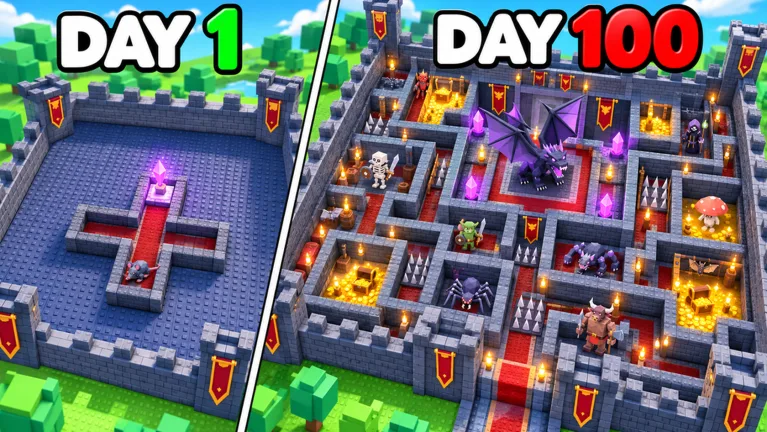
Build a Dungeon Dungeon Building Guide: Corridors, Walls and Traps
A working build a dungeon dungeon building guide for Roblox: lay stone corridors as the real path, cut wooden dead ends, curve walls, place spike, poison, tar pit, bear trap, arrow and fire traps, and keep Coins and Dark Souls spending apart.
Published: Build a Dungeon Wiki Editorial Team
Table of Contents
Lay Stone Corridors as the Real Path
Recorded gameplay of Build a Dungeon shows the one rule everything else hangs on: heroes walk in through a single one-way entrance and follow the corridors the builder connects. Stone corridor tiles carry that traffic, while a wooden floor reads as a dead end and sends heroes back out. That is the skeleton of a build. The stone route is the real path, and every wooden branch is a decoy that costs heroes walking time before they ever reach your units.
Shaping that route is where the other parts earn their place. Curved walls and curved corridors bend the walk instead of letting it run straight, a dead end terminates a branch heroes have to back out of, and crossroads and junctions decide where a wave splits. Recorded builds also include armory, treasure room, dragon nest, graveyard, lava chamber, frost stone wall, wooden barricade, ballista tower, turret, blacksmith, Life Spring and Shrine Tiles pieces, but none of them rescue a short, straight stone route.
Stone Corridor
The mandatory path. Lay it from the one-way hero entrance and keep it continuous, because this is the line heroes actually follow.
Wooden Floor
A dead end by design. Use it for branches that look promising and lead nowhere, so heroes spend time on tiles that pull them away from your defenses.
Curved Wall and Curved Corridor
These turn the route and the sight line. A bend buys damage time and still leaves your units a lane to work in.
Crossroads and Junction
Where one crowd becomes two. A junction feeds the same wave into two trap lanes instead of one.
Where Each Trap Belongs
Recorded builds use a wide trap set: spike trap, poison trap, tar pit, bear trap, wall-mounted arrow trap, fire trap and falling rocks. Only some of that behavior is confirmed in the live footage. Poison trap was priced at 1,000 Coins, tar pit only slows heroes and does no damage of its own, and arrow trap is mounted on a wall rather than on the floor. The developer has not published a full trap price or damage list, so check the in-game interface for the numbers your own build shows.
Placement follows the route rather than the other way around. Tar pit in front of a damage source is worth far more than tar pit on its own, arrow traps need wall tiles facing a corridor heroes must walk, and a junction that bunches a wave into one lane is the best spot for area traps. Keep traps out of tight clusters: recorded gameplay shows the thief class dismantling traps inside a one-tile radius around itself, so a stacked cluster is one thief's easy clear.
Bending the route and splitting a wave into two lanes
Spike trap and falling rocks
Part of the recorded trap set
Straight corridors and junctions that bunch a wave
Poison trap
Recorded at 1,000 Coins
Long stretches heroes walk slowly
Tar pit and bear trap
Tar pit slows heroes only, with no damage of its own
In front of a damage source, where heroes should be held
Arrow trap
Mounted on a wall
Wall tiles facing the mandatory route
Fire trap
Part of the recorded trap set
Tiles oil has already soaked
The Oil and Lava Fire Chain
Oil and lava floor are the pair that turns one bad step into a long burn. Recorded gameplay shows that a hero who steps on oil keeps burning for the next three tiles, and that lava floor raises fire damage. That gives the spacing rule: oil first, then the fire source, then roughly three tiles of burn before the next damage tile, so the hero is still on fire when they reach it.
Run the stone corridor first. Build the mandatory route from the one-way entrance, then mark the stretch where the fire chain should happen.
Lay the oil. Put oil on the tiles before the fire, because the burning state only starts once a hero steps on it.
Add the fire source. Place fire trap or lava floor at the end of that oil stretch so a burning hero walks into raised fire damage.
Count three tiles. Keep about three tiles of burn between the oil and the next damage tile, then chain the pattern again further along, with tar pit or bear trap on the tiles between so heroes stay in the fire for longer.
Because tar pit only slows and never damages, it belongs inside the chain rather than at the end of it. A slowed hero standing in fire takes the same damage for more seconds. The developer has not published exact burn or fire damage values, so check the in-game interface.
Coins for Buildings, Dark Souls for Units
The two currencies do not overlap. Coins pay for buildings, traps and parts, which is the layer you build with: corridors, curved walls, junctions, potion shops, treasure rooms and every trap above. Potion shops are one of the main income sources in recorded gameplay because heroes walk in and buy potions, and a treasure room pulls heroes toward it every time, so both belong on the mandatory route. Dark Souls are the currency for monster units, and recorded gameplay shows unit purchases at 190,000 and 220,000 Dark Souls. Community readings put summon milestones at 80 rolls for Legendary, 160 for Mythic, 300 for Secret and 2,000 for Divine, and the developer has not published the official rates, so check the in-game interface before you commit.
Income decides how fast either side grows. Potion shops are one of the main income sources because heroes buy from them, and the escape menu reports earnings per hour at your highest wave; recorded gameplay at wave 190 showed about 8,400 Coins and 385 Souls per hour. A failed run restarts from the most recent checkpoint, and recorded gameplay shows a checkpoint at wave 10. Skill tree nodes such as trap mastery, population, unit damage, soul harvest and battle speed are the other way to raise what the same route earns. Servers hold six players and the game is still in Beta, so check with the group before rebuilding a shared dungeon, and the official Discord is where updates get posted.
Walk the stone route from the one-way entrance and confirm wooden dead ends branch off it instead of interrupting it.
Add at least one curved wall and one crossroads so the walk is longer than a straight line.
Place oil before the fire source and keep roughly three tiles of burn before the next damage tile.
Put the potion shop and the treasure room on the route heroes must walk.
Spend Coins on buildings and traps before spending Dark Souls on units.
Warning
Recorded gameplay shows that player units cannot attack through walls, while the archer class can. Do not wall your own units off from the corridor they are meant to defend, and expect thieves to dismantle traps within a one-tile radius.
Frequently Asked Questions
What should I build first in Build a Dungeon?
Connect a stone corridor to the one-way hero entrance, because that is the route heroes actually follow, then add wooden floor branches as dead ends once the real path works.
How far apart should oil and fire be?
A hero who steps on oil keeps burning for the next three tiles and lava floor raises fire damage, so place oil before the fire source and keep roughly three tiles of burn before the next damage tile. Exact damage values are unpublished, so check the in-game interface.
Should I save Coins or Dark Souls?
They buy different things: Coins pay for buildings, traps and parts, while Dark Souls are the currency for monster units. Recorded unit purchases reached 190,000 Dark Souls, so build the route with Coins first and save Dark Souls for the unit your route is missing.