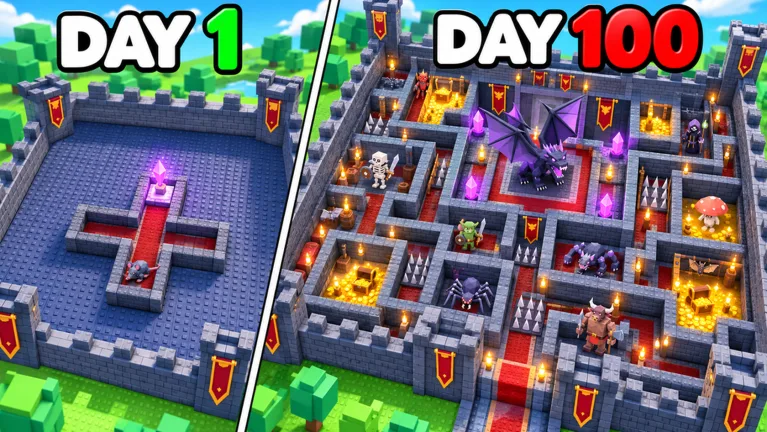
Use this build a dungeon wiki guide for Roblox: verified monster units, trap and layout behaviour, the Coins and Dark Souls economy, roll milestones, and active codes.
Published: Build a Dungeon Wiki Editorial Team
Table of Contents
Build a Dungeon Wiki Overview
[GUILDS] Build a Dungeon is a Roblox simulation and tycoon game developed by Exploration Guild. It is in beta and updates regularly, runs six-player servers, and supports neither voice chat nor camera. The official description sets out the loop directly: build your own dungeon, defeat endless waves of heroes, put monsters in the dungeon to loot heroes, and collect cool buildings and strong monsters for more cash.
You do not raid the dungeon, you run it. Heroes spawn at a one-way entrance, walk the corridors you have laid down, and head for your dungeon crystal; your monster units and traps are what stop them, and the loot those heroes drop is what funds the next round of building. A failed run restarts from the most recent checkpoint, and recorded runs show a checkpoint at wave 10.
Dungeon parts and monster units are both rolled for before you can place them, which is why the roll pool, the rarity ladder and the mutation system matter as much as the layout itself.
Room Layouts, Parts and Trap Placement
Corridor pieces and rooms are rolled for, traps are bought with Coins, and each piece you place changes how long a wave survives on the way to the crystal. Recorded Build Mode sessions show parts such as stone corridors, wooden floors, curved walls, curved corridors, dead ends, crossroads, junctions, armories, treasure rooms, dragon nests, graveyards, lava chambers, frost stone walls, wooden barricades, ballista towers, turrets, blacksmiths, Life Springs and Shrine Tiles.
Corridor Pieces
Stone and curved corridors, dead ends, crossroads and junctions decide the route heroes have to walk, and a dead end turns them back the way they came.
Rooms and Support Buildings
Armories, treasure rooms, dragon nests, graveyards, lava chambers, blacksmiths, Life Springs and Shrine Tiles are the larger pieces placed along that route; Shrine Tiles buff the units around them, and nothing can be placed on the tile itself.
Traps
Spike traps, poison traps, tar pits, bear traps, wall-mounted arrow traps, fire traps, falling rocks, oil and lava floors form the damage and delay layer between the heroes and your units.
Part or Trap
Documented Behaviour
Treasure room
Heroes are guaranteed to head for a treasure room, so it doubles as a deliberate lure.
Potion shop
Heroes stop inside to buy potions, and those purchases are one of the main income lines.
Tar pit
Slows heroes rather than killing them, buying your units more time on target.
Oil
A hero who steps into oil keeps burning across the next three tiles.
Lava floor
Raises fire damage, which is why recorded builds pair it with fire traps.
Arrow trap
Mounted on a wall instead of the floor.
Shrine Tile
Buffs the units placed around it, and the tile itself cannot be built on.
Hero classes decide how a layout holds up. Thief heroes disarm traps in a one-tile radius around themselves, healer heroes restore the health of other heroes, and archer heroes can attack through walls. Your own units cannot attack through walls, so where you put a ranged defender matters as much as which unit you pulled.
Monster Units and the Defensive Roster
Units defend the dungeon: some fight up close, some attack from a distance, and others heal or buff the units near them. Boss units gain 50% more health and damage in a Boss Room, which is what makes the room in front of the crystal worth garrisoning properly.
Roll for Units: Units are rolled for and paid for with Dark Souls, and recorded rolls return defenders such as the Skeleton Warrior, so an early roster is built one pull at a time.
Place Them on the Route: Units attack what walks past them and cannot shoot through walls, so the tiles heroes are forced to cross are the tiles worth defending.
Hold the Boss Room: Boss units get 50% extra health and damage in a Boss Room, so keep your strongest pull for the last room before the crystal.
Manage Duplicates: Update 6 added advanced auto-roll filtering to help with repeated unit and building rolls.
The rarity ladder runs Common, Uncommon, Rare, Epic, Legendary, Mythic, Secret and Divine. Exploration Guild has not published a drop-rate table, so the milestones below are what recorded player runs show rather than developer-confirmed numbers.
Rarity
Reported Roll Milestone
Legendary
80 rolls
Mythic
160 rolls
Secret
300 rolls
Divine
2,000 rolls
Coins, Dark Souls and Booster Potions
Two currencies run the dungeon, and mixing up what they buy is the fastest way to stall. Coins purchase buildings, traps and dungeon parts; Dark Souls are spent on monster units. Both are earned by defeating hero waves and both are handed out by redemption codes.
Resource
What It Is For
Where It Comes From
Coins
Buildings, traps and dungeon parts
Defeated hero waves and redemption codes
Dark Souls
Monster units
Defeated hero waves and redemption codes
Coin Booster Potion
Temporarily raises Coin earnings
Redemption codes such as DRAGONALTAR and DIVINE
Soul Booster Potion
Temporarily raises Soul earnings
Redemption codes such as LABYRINTH and 100KVISITS!
Mutations sit on top of that economy, because a mutated unit costs a multiple of the normal Dark Souls price instead of a flat extra fee.
Mutation
Health and Damage
Dark Souls Cost
Extra Population
Golden
2.4× base
4× base
+1
Frozen
3.8× base
7× base
+2
Infernal
5.6× base
12× base
+2
Cursed
8× base
20× base
+3
Mutations do not change a unit's attack interval, range or ability percentages, and the Boss Room bonus is applied on top of the mutation stats rather than included in them.
Tip
A potion shop inside the route is one of the steadiest income lines in the game: heroes stop and buy potions on their way to the crystal, so the wave keeps paying you even while your units are still weak.
Warning
Exploration Guild has not published unit prices, part costs, roll rates or pity thresholds. Any percentage or price you see outside the game is unverified, so confirm the current values on the in-game interface.
What Updates 6 and 7 Added
Update 6 added the randomly generated three-floor Labyrinth, playable solo or with a group, filled with treasure chests and scaled so that harder runs pay out more. The same update brought Shrine Tiles, Divine and Mutation pity mechanics, advanced auto-roll filtering, and an earlier unlock of the 2x Battle Speed skill-tree upgrade. Update 7 moved the game into its [GUILDS] era: guilds are in beta, and the update notes cover mutation changes, trap upgrades and auto rejoin.
The skill tree behind those upgrades is a set of permanent percentage increases rather than a class system; recorded runs show nodes including gold rush, soul harvest, unit damage, population, trap mastery, battlecry and battle speed.
Active Codes and Reward Redemption
Codes are redeemed inside the game, and the rewards below are the ones trackers agree on. A few amounts are reported differently between trackers, so the message the Redeem window returns is the final word.
Promo Code
Reported Reward
2KCCU!
5k Coins and 3k Dark Souls
DRAGONALTAR
3 Coin Booster Potions, 1k Coins and 3k Dark Souls
LABYRINTH
3 Soul Booster Potions, 10,000 Coins and 1,000 Souls
100KVISITS!
Soul Booster Potion, Coins and Dark Souls; exact amounts unconfirmed
DIVINE
Coin Booster Potion, Coins and Dark Souls; exact amounts unconfirmed
Click the Settings button in the top-left corner of the screen.
Type or paste the code into the text box.
Press Redeem and check that the Coins, Dark Souls or potions arrive.
Codes are case-sensitive, so copy them exactly. New codes are announced through the Exploration Guild community and the official Discord, while the official Roblox game page is the authority on beta status, server size and platform settings (Place ID 119238997901301, Universe ID 10768128625).
Frequently Asked Questions
What is Build a Dungeon?
[GUILDS] Build a Dungeon is a Roblox simulation and tycoon game by Exploration Guild, still in beta, in which you build a dungeon, place monster units and traps, and defend your dungeon crystal against endless waves of heroes.
How do you defend the dungeon crystal?
Heroes enter through a one-way entrance and follow the corridors you place, so defence is a route problem and a damage problem at once: lay the path, fill it with traps, and garrison monster units on the tiles heroes are forced to walk.
What are the currencies in Build a Dungeon?
Coins buy buildings, traps and dungeon parts, while Dark Souls pay for monster units. Coin Booster Potions and Soul Booster Potions temporarily increase what you earn, and both currencies come from defeated hero waves and from redemption codes.
Are the roll rates and pity thresholds published?
No. Exploration Guild has not published drop rates, pity thresholds or prices, so the roll screen and the in-game interface are the authority. The only figures players report are observed milestones: Legendary at 80 rolls, Mythic at 160, Secret at 300 and Divine at 2,000.
Where do I find working Build a Dungeon codes?
Open Settings in the top-left corner, type the code and press Redeem. New codes are announced through the official Discord and the Exploration Guild community, and the Redeem window confirms whether a code still pays.
Does the dungeon keep working while I am offline?
Yes. The official game description states that monsters catch heroes offline.