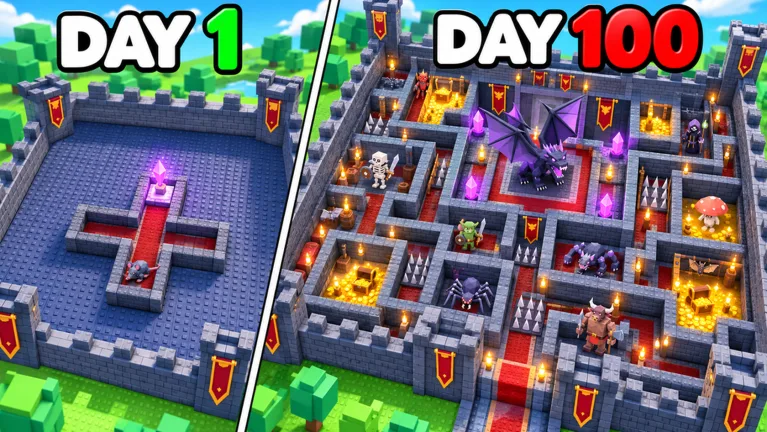
Build a Dungeon Monster Placement Guide: Where to Put Units
Learn build a dungeon monster placement in Roblox [GUILDS] Build a Dungeon: put monster units on the hero path, cover trap tiles, and use rooms and mutations well.
Published: Build a Dungeon Wiki Editorial Team
Table of Contents
How Monster Placement Works in Build a Dungeon
[GUILDS] Build a Dungeon is a Roblox simulation and tycoon game from Exploration Guild, listed as a Simulation / Tycoon experience in beta, with a six-player server size and no voice or camera support. You build your own dungeon, station monsters inside, defeat endless waves of heroes, and protect your dungeon crystal.
Monster units defend that crystal. Recorded gameplay shows some units fighting up close, some attacking from a distance, and others healing or buffing nearby units. Heroes enter through a single one-way entrance and follow the corridor you lay toward the crystal, so the tiles you build are the map your units work on.
Two currencies fund every placement decision. Coins buy buildings and defensive traps, while Dark Souls are spent to roll for or buy monster units. Coin Booster Potions and Soul Booster Potions temporarily raise what you earn, and codes top both currencies up.
Lay the route first: Heroes follow the corridor you build, so decide the path before you buy units.
Choose the kill stretch: Pick one long corridor or open room the wave must cross and treat it as where your damage units live.
Place on open tiles: A unit needs line of sight along the corridor. Walls block your units' attacks and do not block hero archers.
Cover the trap tiles: Thieves disarm traps within a one-tile radius, so trapped stretches need monster units too.
Re-place and re-test: Units can be picked up again, so move anything that never makes contact with the wave.
The Placement Rule That Decides Most Fights
Walls cut one way, and not in your favour. Recorded gameplay shows that monster units cannot attack through walls, while hero archers can hit your units through them. A strong unit parked in a sealed side room contributes nothing to the wave and can still be shot while it stands there. Keep damage dealers on the open corridor tiles and inside the rooms the wave must walk through, and treat a wall as scenery rather than protection.
Placement
What Happens
Verdict
Open corridor tile on the route
The unit attacks heroes as they pass
Best use of a damage dealer
Room floor the wave walks into
The unit fights where heroes must stop and turn
Strong for short-range and support units
Tile behind a wall
The unit cannot attack through the wall, and archers can still hit it
Move it
Tile beside a trapped stretch
The unit finishes heroes a thief left alive
Worth the slot
Build Decoy Paths Before You Place Anything
Because heroes follow the corridor you build, the route itself is a placement tool. Recorded gameplay shows heroes walking into a dead end, turning around, and walking back out, which is extra time your units spend hitting them. Dead ends, curved corridors, crossroads, and junctions all stretch that walk, and long-range units along a decoy corridor get a hit on every pass.
The other half of that strategy is luring heroes into the loop instead of letting them take the short route. Heroes stop at a potion shop for a couple of seconds, which makes it a lure as well as income, and a treasure room is guaranteed to pull heroes toward it. Placing both on a decoy stretch keeps the wave inside your kill zone while it pays you Coins.
The Loop
A decoy section heroes run in circles through, built from curved corridors and dead ends, covered by long-range units.
The Trap Pocket
A corridor where the wave is slowed and burned while units finish whatever survives the traps.
The Boss Room
The room next to your crystal, where a boss unit gains 50% more health and damage and becomes the last line of defense.
One player who pushed deep into the wave count reported roughly five-tile decoy channels funnelling into a corridor of max-level units, with a high-level boss unit kept in the final room before the crystal. The exact length matters less than the separation: the decoy route and the real route must stay apart, because a decoy that becomes the real path sends heroes straight to the crystal.
Cover Traps With Units, Not With Walls
Traps are bought with Coins and placed along the route. Spike traps, poison traps, fire traps, bear traps, falling rocks, and wall-mounted arrow traps deal damage; tar pits slow heroes down; oil sets a hero on fire for the next three tiles; and lava floor increases fire damage. Wall-mounted arrow traps are the exception to the wall rule, because they are placed on a corridor or room piece rather than on open floor.
Placement is what makes those traps pay. A slowed or burning hero stays inside your units' range longer, so slowing traps and damage traps belong on the same stretch of corridor rather than in separate sections. Recorded gameplay shows a pattern of oil, three empty tiles, then oil again, repeated along the corridor, which keeps the burn reapplied instead of letting it lapse.
The counter to plan around is the thief, which disarms traps within a one-tile radius. A corridor held together by traps alone opens up the moment a thief walks through, which is why monster units should sit behind the trap line. Healers restore health to other heroes, so damage from a single unit can be undone; sharing one stretch of corridor between several units and traps solves both problems at once.
Warning
Do not treat a wall as a shield for a unit. Hero archers attack through walls, so a unit behind a wall can be shot without being able to answer, and it will not help against the heroes walking past it.
Population, Rarity, and Roll Limits
How many units you can field is a placement limit as much as a combat stat. Units come in Common, Uncommon, Rare, Epic, Legendary, Mythic, Secret, and Divine tiers, and the rarer the tier, the more rolls it takes to reach. Recorded gameplay shows roll milestones of 80 rolls for a Legendary, 160 for a Mythic, 300 for a Secret, and 2,000 for a Divine unit. Official drop rates and pity thresholds have not been published, so confirm current values in the game's interface.
Mutations are the biggest single change a placed unit can carry. A mutated unit keeps its attack interval, range, and ability percentages, but its health, damage, Dark Souls cost, and population cost all rise.
Mutation
Health and Damage
Dark Souls Cost
Extra Population
Golden
2.4× base
4× base
+1
Frozen
3.8× base
7× base
+2
Infernal
5.6× base
12× base
+2
Cursed
8× base
20× base
+3
Because every mutated unit also costs extra population, a few mutated units on the route usually beat a crowd of normal units scattered across the dungeon. The skill tree covers the rest of the placement budget rather than one unit at a time: its nodes include gold rush, soul harvest, unit damage, population, trap mastery, and battlecry, and Update 6 moved the 2x Battle Speed upgrade earlier in the tree. Population is the node to watch when your best units no longer fit, and Update 6 also added auto-roll filtering to manage the repeated rolls you accumulate while chasing one specific piece.
Boss Units and Late-Wave Placement
Boss units get 50% more health and damage in a Boss Room, so if you own one, the room in front of the crystal is where it earns its Dark Souls. Keep the boss unit there as the last line of defense and let the decoy corridors and trap stretches do the earlier work, because a boss unit parked at the entrance is one the wave can walk past.
The endgame content changes what you are placing for. Update 6 added the Labyrinth, a random three-floor dungeon with chests and difficulty-scaled rewards that can be run solo or in a group, plus Shrine Tiles and the Divine and Mutation pity systems. Update 7 moved Guilds into beta with mutation changes, trap upgrades, and auto rejoin. If a wave destroys your crystal you restart from the nearest checkpoint instead of wave one, and the official description confirms that monsters catch heroes offline as well, so a layout that fails is one you can fix.
Tip
Set up one strong kill stretch instead of spreading units evenly. Several units and trap tiles sharing the same corridor overwhelm healers, while single units spaced far apart let heroes heal up between fights.
Confirm every damage dealer stands on an open tile with the hero path in front of it.
Confirm no unit is sealed behind a wall where it cannot attack.
Confirm each trapped stretch is also covered by at least one monster unit for thieves.
Confirm the decoy route cannot be mistaken for the real route to the crystal.
Confirm your boss unit sits in the Boss Room rather than at the entrance.
Confirm your population budget still fits after adding mutated units.
Frequently Asked Questions
How do I place monster units in Build a Dungeon?
Units are placed by hand on the tiles you built. Roll or buy a unit with Dark Souls, set it down on an open corridor tile or room floor the wave has to cross, and pick it back up if it never makes contact.
Can monster units attack through walls?
No. A wall blocks your unit's attacks, while hero archers can attack your units through walls. Place damage dealers on open tiles and never rely on a wall for protection.
Where should I put my strongest unit?
In the Boss Room near your crystal if it is a boss unit, because boss units gain 50% more health and damage there. Other strong units belong on the longest corridor the wave must walk, ideally beside slowing traps such as tar pits and oil.
What should I do about thieves and archers?
Treat them as placement problems rather than stat problems. Thieves disarm traps within a one-tile radius, so keep monster units covering trapped stretches, and archers shoot through walls, so keep units on open tiles instead of behind cover.
Do official drop rates matter for placement?
Official drop rates and pity thresholds have not been published, so use the in-game interface for current numbers. The 80, 160, 300, and 2,000 roll milestones come from recorded gameplay, so treat them as a planning guide rather than a guarantee.