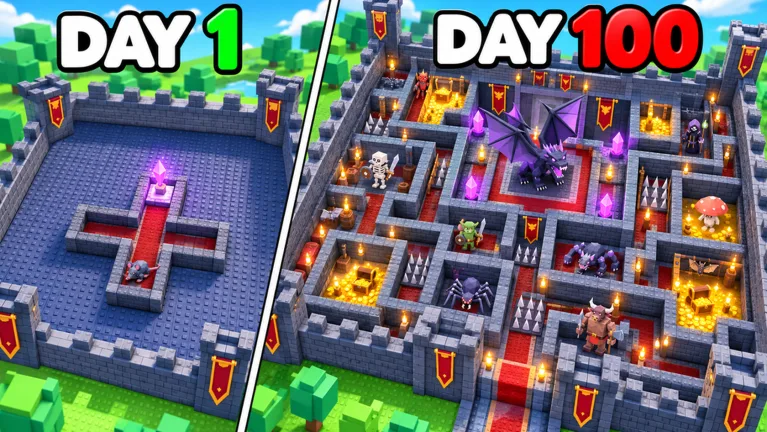
Build a Dungeon Tips and Tricks: Roblox Coins, Traps and Waves
Use these build a dungeon tips and tricks to route heroes through oil and fire traps, earn Coins from potion shops, and roll stronger monster units in Roblox.
Published: Build a Dungeon Wiki Editorial Team
Table of Contents
Introduction: What Actually Keeps Your Crystal Alive
Build a Dungeon is a Roblox simulation and tycoon game from Exploration Guild, in beta as [GUILDS] Build a Dungeon (Place ID 119238997901301, six-player servers, no voice chat or camera support). You lay the corridors, place monster units and traps, and hold a dungeon crystal against endless waves of heroes.
Three habits decide how far you get: make heroes walk further, make every step hurt, and turn the traffic into Coins.
Core Systems to Understand First
The Dungeon Crystal
The crystal is your loss condition. Heroes that reach it destroy it, so every corridor, trap and unit exists to buy damage time before they arrive.
The Hero Route
Heroes spawn at one one-way entrance and follow the tiles you connect. A dead end sends them back out, so wrong turns cost them time inside your defenses.
The Economy
Coins pay for buildings, traps and parts, Dark Souls buy monster units, and potion shops add income from the heroes themselves.
Resource
What It Buys
Where It Comes From
Coins
Buildings, traps and parts
Defeated hero waves, potion shops, codes
Dark Souls
Monster units from rolls
Defeated hero waves, codes
Booster Potions
Temporary boosts to earnings and drop rates
Codes and in-game shop offers
Layout Tips That Survive Higher Waves
Recorded high-wave builds almost never run straight to the crystal. One long run kept a single tile as the real route while the wooden floor pieces beside it were dead ends, so heroes that picked wrong walked back out. Curved corridors, crossroads and junctions stretch that walk and push heroes past the same traps twice.
Anchor the entrance. Start your first stone corridor at the one-way hero entrance.
Break the straight line. Use curved corridors, crossroads and junctions instead of one open run, and branch into dead ends.
Place potion shops and a treasure room. Heroes stop to buy potions and always head for a treasure room, so both belong on the long route.
Buildable Piece
Role
How to Use It
Stone corridor
Defines the hero route
The main path away from the entrance
Curved corridor, crossroads, junction
Direction changes and splits
Stretch the walk and re-expose heroes to traps
Dead end
Turns heroes around
Branches that waste hero time
Potion shop
Coin income
On the main route, where every hero stops
Treasure room
Lure
On the long route; heroes always head for it
Ballista tower, turret, frost stone wall, wooden barricade
Shrine Tiles buff nearby units and block building on them
Warning
Hero classes punish lazy layouts: a thief disarms traps within a one-tile radius around itself, and healers keep damaged heroes alive, so one spike corridor will not hold. Mix trap types and keep combat units behind the trap line.
Trap Tips: Stack Damage Instead of Spreading It
Chain oil into fire instead of scattering one trap of every kind. A hero who steps on oil keeps burning for three tiles, so recorded builds leave a three-tile gap between oil patches and layer fire traps and lava floor on top. Fire traps are the only traps that gain a damage buff from oil.
Trap
Effect
Practical Note
Spike trap
Direct damage
A cheap, reliable starter trap
Poison trap
Damage over time
Mid-route trap in recorded builds
Tar pit
Slows heroes
Pair it with damage traps
Arrow trap
Wall-mounted ranged trap
Buy it whenever it appears
Fire trap
Fire damage
Oil turns it into bonus damage
Falling rocks
Heavy hit damage
Used against tougher heroes
Oil and lava floor
Oil burns for three tiles; lava raises fire damage
Leave three tiles between oil patches
Monster Units, Rolls and Mutations
Dark Souls buy the rolls that produce monster units, and the pool follows the rarity ladder: Common, Uncommon, Rare, Epic, Legendary, Mythic, Secret and Divine. Recorded runs show milestone rolls at 80 for a Legendary, 160 for a Mythic, 300 for a Secret and 2,000 for a Divine. Official odds are not published, so read the counter in game.
Mutation
Health and Damage
Dark Souls Cost
Extra Population
Golden
2.4x base
4x base
+1
Frozen
3.8x base
7x base
+2
Infernal
5.6x base
12x base
+2
Cursed
8x base
20x base
+3
Mutations do not change attack interval, range or ability percentages, so the multiplier is pure health and damage. Boss units such as the Skeleton King, Lich Lord and Banshee Queen gain 50% more health and damage in a Boss Room, and Update 6 added advanced auto-roll filtering for repeated rolls.
Skill Tree, Updates and Labyrinth Runs
The skill tree holds permanent percentage upgrades; nodes seen in recorded play include Gold Rush for Coin income, Soul Harvest for Dark Soul income, unit damage, population, trap mastery, battlecry and battle speed, with Update 6 unlocking 2x Battle Speed earlier. Update 6 also added random three-floor Labyrinth runs (solo or grouped, with chests and difficulty-based rewards), Shrine Tiles, and Divine and Mutation pity. Update 7 moved Guilds into beta with mutation changes, trap upgrades and auto rejoin. Pity thresholds and drop rates are not published, so check the in-game interface.
Tip
Codes top up a stalled economy fastest: 2KCCU! gives 5k Coins and 3k Dark Souls, and DRAGONALTAR adds Coin Booster Potions, Coins and Dark Souls. Enter them under Settings in the top-left corner and press Redeem; more codes are on our codes page.
Common Mistakes That Cost You Waves
Units cannot attack through walls, so a ranged unit behind solid stone is dead weight until a hero walks into its line. Hero archers ignore that rule and shoot through walls, which is why recorded builds treat them as a wave's first real threat.
The escape menu shows an hourly Coin and soul rate based on your highest wave; one recorded run showed roughly 8,400 Coins and 385 souls per hour. A failed wave restarts from your latest checkpoint, and recorded play showed a checkpoint at wave 10. The official page confirms monsters keep catching heroes offline, so a solid layout keeps paying while you are away.
[ ] Does every hero have to pass your potion shops and your trap chain?
[ ] Is your treasure room on the long route instead of next to the crystal?
[ ] Do your ranged units have clear lines of sight against hero archers that shoot through walls?
[ ] Are your boss units standing in a Boss Room for the 50% bonus?
Potion shops are the steadiest source: heroes stop to buy potions on the way in and you collect the payment, so more shops on the route means a higher hourly rate. Waves and codes add Coins and Dark Souls too.
What is the best layout for defense?
A route that never runs straight: curved corridors, crossroads and junctions to stretch the walk, dead ends to turn heroes around, and stacked oil, fire and lava floor traps where they walk. A treasure room guarantees hero attention, so use it as bait.
How do I get Legendary, Mythic and Secret units?
Roll with Dark Souls. Recorded runs show a Legendary at 80 rolls, a Mythic at 160, a Secret at 300 and a Divine at 2,000. Official rates are not published, so check the in-game counter before spending.