Build a Dungeon Beginner Guide: Your First Session Explained
A build a dungeon beginner guide for Roblox [GUILDS] Build a Dungeon: lay the corridor from the one-way hero entrance, place starter monsters and traps, split Coins from Dark Souls, and use the wave 10 checkpoint.
Published: Build a Dungeon Wiki Editorial Team
Table of Contents
What the Build and Defend Loop Asks of You
The official description of Build a Dungeon is short: build your own dungeon, defeat endless waves of heroes, put monsters in the dungeon to loot heroes, and collect buildings and strong monsters for more cash. It is an Exploration Guild experience listed as a Simulation / Tycoon game in beta that updates regularly, with six-player servers and no voice or camera support. Monsters catch heroes offline, so a dungeon keeps working while you are away.
A first session asks for less than the unit list suggests. You build a route from the single one-way entrance, spend Coins on the pieces and traps along it, spend Dark Souls on the monsters that stand on it, and then let a wave test it.
Lay one corridor: Start with stone corridor pieces from the one-way hero entrance, because the stone corridor is the main path heroes follow.
Trap the route: Traps are bought with Coins, so your first Coins belong on the corridor instead of in savings.
Station starter units: Dark Souls pay for monster units, and recorded gameplay shows single purchases priced at 190,000 and 220,000 Dark Souls, so begin with the lower tiers.
Run a wave and find the leak: Watch the exact stretch where heroes get through, because that stretch is what you fix first, then leave the dungeon to keep catching heroes offline.
The One-Way Entrance and the Corridor You Lay
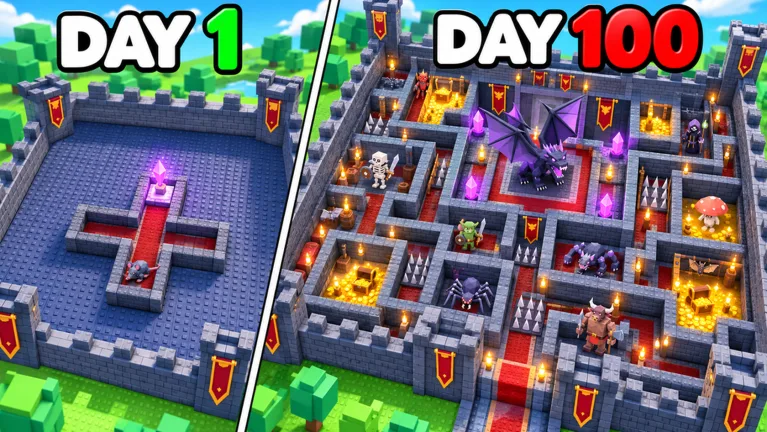
Heroes enter through a single one-way entrance and follow the corridor you lay. Nothing is generated for you: the stone corridor pieces are the main path, while wooden floor reads as a dead end, so a hero walks in, turns around, and walks back out. Recorded gameplay also shows curved walls, curved corridors, dead ends, crossroads, junctions, armories, dragon nests, graveyards, lava chambers, frost stone walls, wooden barricades, ballista towers, turrets, blacksmiths, Life Spring, and Shrine Tiles as pieces you can build with. The route is also your income, because heroes stop at a potion shop to buy potions, which recorded gameplay shows as one of the biggest sources of Coins, and a treasure room is guaranteed to pull heroes toward it. Put both on a stretch the wave must cross so the detour pays you while your units work.
Piece
What the evidence supports
Stone corridor
The main path heroes follow from the one-way entrance
Wooden floor
A dead end: heroes walk in, turn around, and walk back out
Potion shop
Heroes stop there to buy potions, one of the biggest Coin sources in recorded gameplay
Treasure room
Heroes are always pulled toward it, so it works as a lure
Placing Starter Monster Units and Traps
Units come in eight tiers: Common, Uncommon, Rare, Epic, Legendary, Mythic, Secret, and Divine. A first session lives in the bottom two, where Common offers Bone Ghoul, Goblin Scout, Sewer Rat, Skeleton Warrior, and Slime, and Uncommon adds Cinder Kobold, Dire Wolf, Dusk Bat, Goblin Archer, Goblin Stabber, Grave Sentinel, and Imp Trickster. Roll milestones in recorded gameplay only cover the top tiers; the developer has not published this, so check the in-game interface for live prices and drop rates.
Placement decides whether those units do anything. Monster units cannot attack through walls, while hero archers can attack through them, so a unit parked behind a wall deals no damage and can still be shot. Keep units on the open corridor tiles the wave has to cross, and remember that mutations do not change attack interval, range, or skill percentages, while a boss unit placed in the Boss Room gains 50% extra health and damage. Traps are bought with Coins and sit on the same route: spike trap, poison trap, tar pit, bear trap, wall-mounted arrow trap, fire trap, falling rocks, oil, and lava floor. Tar pits only slow a hero down, oil sets a hero on fire for the next three tiles after it is stepped on, and lava floor increases fire damage. Recorded gameplay shows a poison trap priced at 1,000 Coins. Two hero classes answer traps directly: the thief disarms traps within a one-tile radius around itself, and the healer restores health to other heroes, so one unit's damage can be undone.
The Kill Stretch
One long corridor the wave must cross, where your units stand on open tiles with line of sight and the traps sit under the heroes' feet.
The Decoy
A wooden dead end or a loop that pulls heroes off the direct route, so they walk extra ground before reaching the rest of the dungeon.
The Income Stop
A potion shop or treasure room on the route, so the wave pays you Coins while it walks toward your damage.
Coins and Dark Souls: What Each Currency Buys
The split is clean. Coins buy buildings and defensive traps. Dark Souls buy monster units and the rolls that produce them, which is why unit prices in recorded gameplay reached 190,000 and 220,000 Dark Souls while a recorded poison trap cost 1,000 Coins. Coin Booster Potions and Soul Booster Potions raise what you earn for a while, and verified codes top both currencies up; redeem them from the Settings menu in the top-left corner of the screen. Income grows with how deep you push: the escape menu shows hourly earnings based on your highest wave, and recorded gameplay at wave 190 showed roughly 8,400 Coins and 385 Souls per hour. The skill tree spends on the same loop, with nodes for unit damage, population, trap mastery, battlecry, battle speed, and two income nodes, and Update 6 unlocked 2x Battle Speed early.
Tip
Traps are the cheaper half of your defense. Recorded gameplay shows a poison trap priced at 1,000 Coins while single unit purchases were listed at 190,000 and 220,000 Dark Souls, so buy the trap line before you save for another monster.
The Wave 10 Checkpoint and What to Fix When Waves Leak
A failed run restarts from the most recent checkpoint rather than from the beginning. Recorded gameplay shows a checkpoint at wave 10, and the run resumed from wave 10 after the failure, so the opening waves only have to be solved once. That makes wave 10 the first honest test of your layout: everything before it is setup, and everything after it repeats the same corridor against harder waves. When waves start leaking, fix in this order: first, find units that cannot see the route, because your units cannot attack through walls while hero archers can, which wastes anything standing behind one; second, check the trap line, since a thief disarms traps within a one-tile radius and a trap-only corridor opens up the moment one walks through; third, change the walk itself by adding a wooden dead end, a curve, or a treasure room that pulls heroes off the direct route. Only then spend Dark Souls on more units.
Confirm every damage unit stands on an open tile with line of sight down the corridor.
Confirm the trap stretch has monster units behind it, in case a thief disarms the traps.
Confirm Coin income still covers replacing the traps a thief takes out.
Frequently Asked Questions
What should I build first in Build a Dungeon?
Build one stone corridor from the one-way hero entrance, put Coin-bought traps on it, and only then station your starter monster units on the same stretch.
How does the wave 10 checkpoint work?
A failed run restarts from the most recent checkpoint, and recorded gameplay shows a checkpoint at wave 10 that resumes the run from wave 10 instead of wave 1.
Do monsters keep catching heroes while I am offline?
Yes. The official description states that monsters catch heroes offline, so your dungeon keeps earning between sessions. Updates and community help are posted in the official Discord.